The cost problem for e-methane
E-methane is chemically identical to natural gas and can be injected straight into the existing gas grid. Its value above the commodity gas price depends almost entirely on certification. Only e-methane that qualifies as a Renewable Fuel of Non-Biological Origin (RFNBO) counts toward the RED III targets, so only certified volume earns a premium backed by regulation. In this study, nearly three quarters of project revenue depends on that certificate.
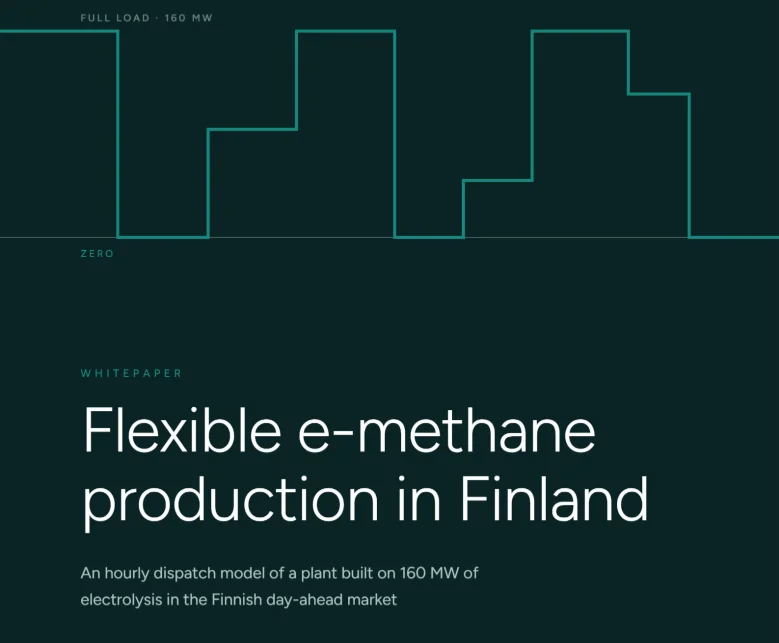
Electricity is the largest variable cost, and electrolysis uses 97 percent of it. The usual answer is a wind power purchase agreement (PPA). This whitepaper tests that answer. Written by Alquion with Freija, it uses an hourly dispatch model of an e-methane plant built on 160 MW of electrolysis, trading in the Finnish day-ahead market. The model measures how operational flexibility and electricity procurement change the levelized cost of methane (LCOM) and project returns.
Why flexibility decides the cost of e-methane
A pay-as-produced wind PPA delivers power on the wind profile. When the wind drops, a plant held at a minimum load has to buy the shortfall on the day-ahead market. Low-wind hours are usually expensive hours. A fully flexible plant shuts down in those hours and produces when the PPA delivers or prices are low.
The RFNBO rules make this flexibility more valuable. From 2030, renewable electricity must be matched to production hour by hour. Grid electricity also counts as renewable in any hour where the day-ahead price sits below a ceiling of 0.36 times the EU ETS allowance price. At 100 EUR per tonne of CO2, that ceiling is 36 EUR per MWh. A plant that can stop and start at will can buy only in those hours, and everything it makes qualifies. That is enough to stay compliant without a PPA.
The results follow in three steps.
- Full flexibility. Moving from constant load to full flexibility under a 320 MW wind PPA lowers LCOM by 32 percent, from 3.74 to 2.54 EUR per kg. The plant runs fewer hours, which adds 0.36 EUR per kg in capital cost. But the average price it pays for electricity falls from 53 to 33 EUR per MWh, which saves 1.01 EUR per kg.
- No PPA. For a fully flexible plant, holding no PPA at all is the cheapest option. LCOM falls by a further 16 percent to 2.14 EUR per kg, because the average power price drops 73 percent, to 9 EUR per MWh. Project IRR rises from 4.98 to 8.25 percent. LCOM rises at every PPA size above zero, so this is not an edge case of the model.
- A higher ceiling. The regulator holds the last lever. Raising the ceiling multiplier from 0.36 to 0.8 times the ETS price, or 80 EUR per MWh, lifts the capacity factor from 0.64 to 0.80. LCOM falls to 2.02 EUR per kg and IRR rises to 9.84 percent. That ceiling sits just below 82 EUR per MWh, the price at which certified production stops covering its electricity and CO2 inputs. Raising the ceiling further adds little.
The absolute returns follow from an assumed green methane price of 190 EUR per MWh, including the certificate. The paper therefore reports the difference between configurations, not a bankable case.
Headline results
- Full flexibility lowers the levelized cost of e-methane by 32 percent, from 3.74 to 2.54 EUR per kg, under an identical 320 MW wind PPA.
- For a fully flexible plant, the cheapest procurement strategy is no PPA at all. This cuts the levelized cost by a further 16 percent to 2.14 EUR per kg and lifts project IRR from 4.98 to 8.25 percent.
- Without a PPA, the average price paid for electricity falls 73 percent, from 33 to 9 EUR per MWh, because the plant buys only in hours that qualify as renewable.
- Raising the RFNBO grid-price ceiling to 0.8 times the ETS price lowers the levelized cost to 2.02 EUR per kg and raises IRR to 9.84 percent.
Want to know what full flexibility means for your e-fuel project?
The Flexolyser is Alquion’s fully flexible alkaline electrolyser, built to shut down to zero output and restart when qualifying power returns. If you are developing an e-methane project or deciding whether you need a PPA, we are happy to run the numbers with you. Download the whitepaper or get in touch.