The RFNBO compliance challenge
Renewable hydrogen producers in Europe increasingly face a choice between maintaining the technical minimum load by drawing expensive and high-carbon electricity from the grid or shutting off the stacks in the absence of qualifying renewable electricity. Under Directive (EU) 2018/2001 as recast by Directive (EU) 2023/2413 (RED III) and its implementing regulations, only hydrogen produced from electricity that meets strict temporal and geographical correlation criteria can be counted as a Renewable Fuel of Non-Biological Origin (RFNBO) and issued a Proof of Sustainability. The hydrogen must also save at least 70 percent of the greenhouse gas emissions of the fossil comparator.
This paper argues that a project's RFNBO share is what decides its business case, and that reaching a full share depends on how the plant behaves in the hours when compliant renewable electricity is unavailable. Those hours are expensive on the day-ahead market, and hydrogen made in them cannot be declared, so the output that costs the most to produce is also the output that earns the least. It is also dirtier than the unabated steam methane reforming (SMR) that RFNBOs are meant to displace.
Why electrolysers must be fully flexible
For a grid-connected electrolyser, the share of output that can be declared RFNBO compliant is what decides the business case. RFNBO hydrogen counts toward the RED III reduction targets, which gives it a market and a premium price. In order to be RFNBO compliant, the produced hydrogen must meet the requirements set out in the delegated regulations, including a 70 percent carbon reduction and hourly matching of renewables generation versus consumption from 2030. Hydrogen that misses the threshold loses access to the certification and associated price premium. In 2025 certified RFNBO volumes traded between 7 and 10 EUR/kg against just over 2 EUR/kg for grey hydrogen.
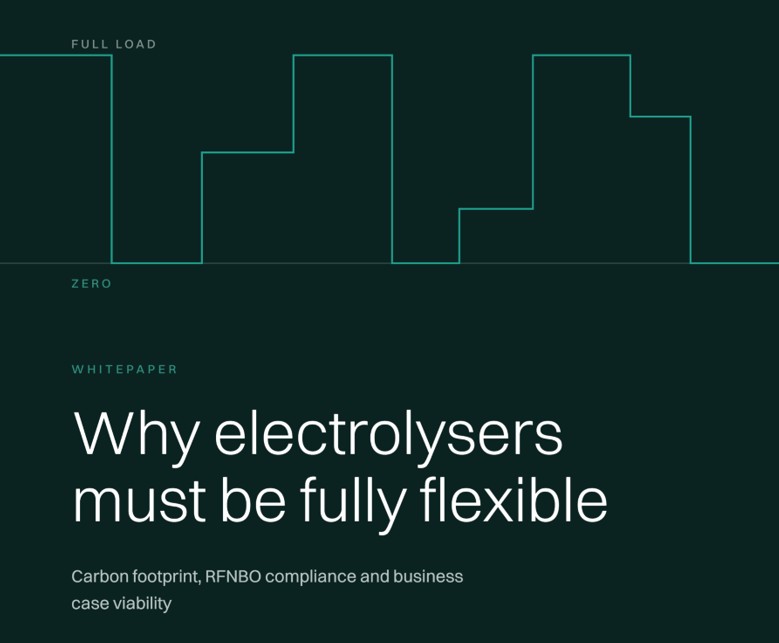
An electrolyser plant will encounter hours in which its own renewable supply via power purchase agreement (PPA) falls short, these hours are both the most expensive and have the highest CO2 emission. Conventional alkaline stacks cannot run below a minimum load, typically 20 to 30 percent of nameplate capacity. To meet this minimum load requirement, it will either draw from the grid or shut down the stack. Two options with significant downsides. A small grid share disqualifies everything produced in that hour, according to RVO's certification guidance. Those hours averaged around 100 EUR/MWh in the Netherlands and Germany in 2025, so the power bill goes up in the same hours the hydrogen loses its price, which makes that output loss-making most of the time. The carbon result is no better. Implied carbon intensity in those hours averaged 14.1 kg CO2 per kg H2 in the Netherlands and 19.9 kg in Germany, against 9 to 11 kg for unabated SMR, so the hydrogen is dirtier than the route it is meant to replace.
The alternative is shutting the stacks down when renewable supply is not available, resulting in irreversible damage to the electrodes due to reverse current and reducing the lifetime and efficiency of the stack with each start/stop sequence. An operator would be choosing between an hour that produces non-RFNBO hydrogen and a stack that reaches the end of its life sooner. Avoiding both requires a technology that can shut down completely without degrading.
Techno-economic modelling shows full shutdown capability is worth close to eight percentage points of project IRR, an uplift of 82.2 percent. For a 100 MW grid-connected reference project with offshore wind PPA, an alkaline plant with a 30 percent minimum load returns a project IRR of 9.5 percent, one with a 20 percent minimum load returns 12.4 percent, and a plant that can shut down to zero returns 17.3 percent. Capital and fixed costs are similar in all three cases.
Flexibility has further value that this paper describes but does not quantify, such as easing grid congestion where offshore wind comes ashore and using hours that a wind farm would otherwise curtail.
Headline results
- Project IRR rises from 9.5 percent at a 30 percent electrolyser minimum load, and 12.4 percent at a 20 percent minimum load, to 17.3 percent with no minimum load, on a 100 MW grid-connected reference project with comparable capital and fixed costs.
- Non-compliant hours in the Netherlands and Germany averaged 101 to 104 EUR per MWh in 2025, so the output that cannot be declared is also the output that costs the most to make.
- Implied electrolysis carbon intensity in those hours averaged 14.1 kg CO2 per kg H2 in the Netherlands and 19.9 kg in Germany, against 9 to 11 kg for unabated SMR and a 3.39 kg RFNBO ceiling.
Want to know what full flexibility means for your project?
The Flexolyser is Alquion's fully flexible alkaline electrolyser, designed to switch on and off without compromise. Whether you are developing a grid-connected electrolyser project or looking at your RFNBO share, we are happy to think along. Get in touch with us.